The Vintage Reissue series was essentially Fender's first serious attempt to rediscover its roots, and reproduce its golden-era instruments from the fifties and sixties. That effort helped form the culture, expertise, and customer demand that eventually led to the founding of the Fender Custom Shop.
It’s October 1982… I just started my first year of high school. Like most people, I was ever the awkward freshman, a little over fourteen years old, trying to feel my way into a new school, new faces… trying to fit in. The one constant was my complete fascination with the guitar and my addiction to Guitar World magazine.
That’s when I first saw the ads for the new Vintage Reissue Stratocasters from Fender. “The Sound that Created Legends”, stated the ad, along with little vignettes of Hendrix, Buddy Holly and Clapton, armed with old strats. Granted, at this point in my life, I was much more obsessed with Eddie Van Halen and his hyper cool Frankenstrat, than some old-school Strat. But I always loved the Strats. Our next-door neighbor Pam used to babysit me, and her boyfriend Clay had a real Stratocaster. I remember thinking it was one of the coolest things I’d ever laid eyes on.
Fast forward seven or eight years – I am now in my early twenties and playing the Detroit rock scene with my hair metal band. My high school buddy and long-time friend Billy had a Vintage Reissue Strat in what appeared to be Sherwood Green… I fell in love with it. Billy wasn’t playing it much and I bought it off him. I fixed the Strat up and I even recall using it to compete in a Detroit guitar competition at the Ritz in Roseville. Sometime afterward, Billy was over my house and he re-connected with the Strat… asked me to borrow it. (I’ve had a long, fun relationship with the guys I’ve grown up with where we ‘keep it in the family’ and borrow guitars from time-to-time). This is one of those times where things didn’t necessarily work out in my favor: Billy called and said he couldn’t give the guitar back; he had fallen in love with it and was keeping it.
I couldn’t begrudge him, but I did feel like I missed out. Soon afterwards, local Detroit guitar legend Bobby East (who’s a long-time friend and a phenomenal guitarist in his own right) called me up and said “Phillip – did you ever get that reissue Strat back from Billy?” When I said the guitar appeared to be gone for good, Bobby said “there’s a killer ’62 reissue in Fiesta Red, here at a store by my house on the east side… you should tell Billy to buy you this one to make things even.”
God bless Bobby; I called Billy and said “Hey, are you still keeping that Sherwood Green Strat? If so, Bobby found a ’62 reissue at a store by his house… why don’t you buy me that one to make up for it?”
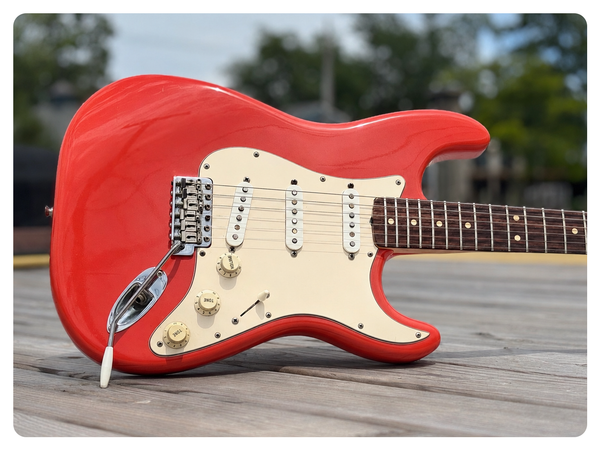
A couple days later, I had the ’62 fiesta red Strat. Still have it to this day. The guitar has served as the cornerstone in my collection of early Vintage Reissue Strats, and the catalyst for my lifelong fascination with this model.
Traveling Back in Time. A host of changes had befallen the Stratocaster’s core design, following CBS’ purchase of Fender in 1965. The changes hit in the fall of 1971. These included the new three screw neck attachment with the “Tilt Neck Adjustment” mechanism, the “bullet” head-stock truss rod, and the end of the stagger-poled pickups. Perhaps most significant was the elimination of the original Fender vibrato bridge’s cold-rolled steel block and bent steel saddles, replaced with components made from diecast alloy – intended for cheaper and easier fabrication.
These significant changes became indicative of the diminished quality of Fender Stratocasters in the 1970s. And, frankly, they didn’t sound the same. By the early eighties, there existed a growing demand for pre-CBS Stratocasters. Moreover, Japanese manufacturers like Tokai were producing more authentic style Stratocaster copies and beating Fender at their own game.
Shakeup in Management. CBS responded by recruiting three executives from the US operations of Japanese instrument manufacturer Yamaha. John McLaren was made head of CBS’ Musical Instruments Division; Bill Schultz became President of Fender, and Dan Smith was named director of marketing for Fender’s electric guitars.
Enter John Page, who had been hired by Fender in 1978. He spent nine years working in guitar research and development. Dan Smith and John Page became the dynamic duo to lead the Vintage Reissue campaign. Together, they traveled the country gathering specifications of vintage Stratocasters from the fifties and sixties.
By December of 1981, Page completed prototypes of the Vintage Reissue “57” and “62” Stratocasters, and the two models were introduced at the NAMM Convention in Anaheim, CA in January of 1982. Fender went on to publish a hot new catalog and dealer demand confirmed management’s instincts.
However, Fender’s production facility in Fullerton, CA needed significant re-tooling in order to produce the Vintage Reissue models. Consequently, the first models did not hit dealers’ shelves until the end of the year.
CBS Changes the Game. Despite the initial demand and apparent success of the Vintage Reissue launch, CBS had lost interest in operating Fender and decided to sell the company. Although many big suitors courted CBS for Fender, none appeared to tender offers that would be any more profitable than simply putting Fender into liquidation.
Fender President Bill Schultz and his executive team entered into a management buyout of Fender, a deal that was consummated on March 5, 1985.
However, the deal excluded the Fullerton factory and left the new management team without a facility to manufacture guitars. Consequently, USA production of Fender guitars effectively ceased after February of 1985. Employee counts at Fender went from over 800 people in 1984, to slightly over 100 by early 1985.
While the hunt was on for new ground, Fender’s management relied on new business relationships with Japanese company partners to fill the gaps. The new “Fender Musical Instruments Corporation (FMIC)” started building a new factory in Corona, CA.
Meanwhile, the team had been stockpiling bodies and necks from the previous operations, and began to purchase some production machinery. By the end of 1985, the new Corona facility was able to restart production albeit on a drastically reduced scale. As regards the Vintage Reissue Series, the team was building approximately five guitars per day, using much of old stock from the previous Fullerton operations.
Worth noting: the proper name of the model is the original ‘Vintage Reissue’ series (1982 – 1987), not to be confused with the American Vintage Reissue (AVRI) series, when the series was renamed in 1988. The very early models are also referred to by collectors as “Fullerton Reissues” which denote when the original models were first produced at the Fullerton, CA factory until February, 1985.
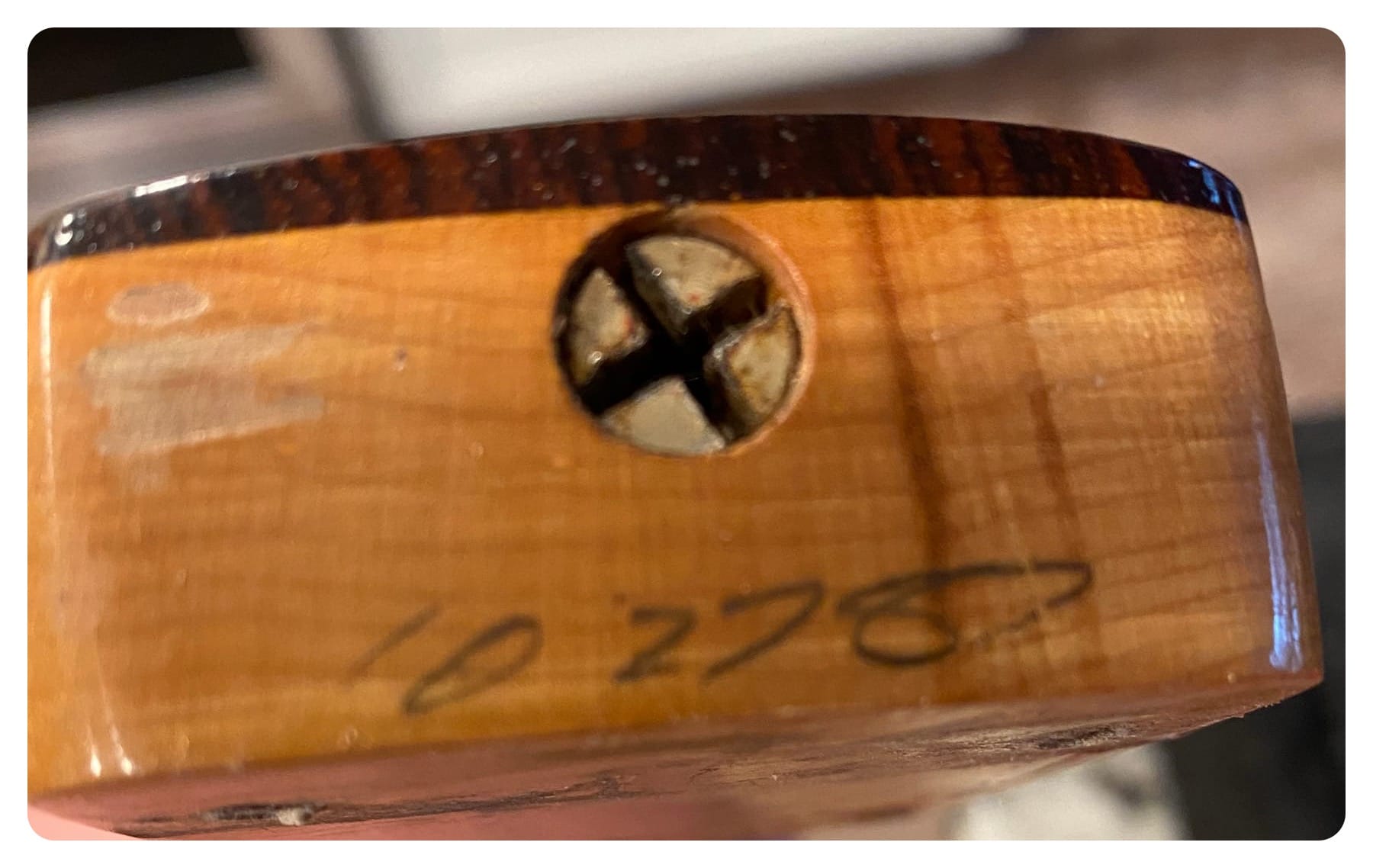
The ’62 Fiesta Red Strat. Let’s get back to the first Vintage Reissue guitar that Billy bought for me. The guitar has serial number V029548. Among the many unique features of these guitars, one note hearkens to their hand-made production: There is a pencil inscription of the neck production date, written at the bottom of each neck heel. This guitar’s neck is 10-27-87.
Neck heel of the '62 Reissue showing pencil date of 10-27-87
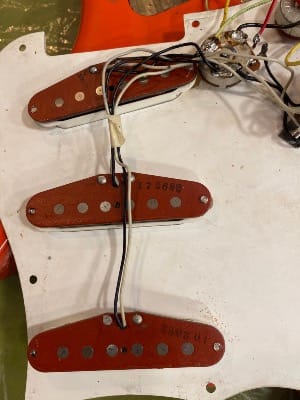
That squarely makes this guitar a Corona produced model, save for another odd feature; the guitar has red-bottom pickups.
The Vintage Reissue Series featured three different types of single coils with flat (not rounded or beveled) pole pieces: Red-bottom, grey-bottom, and black-bottom pickups. Sometimes, you might find an early model with some combination of two or three of these color types. As the years progressed, the black bottom eventually became the standard version.
So if my guitar was clearly produced in Corona, why does it have these red-bottom pickups, which would be indicative of early Fullerton production?
Red-bottom pickups in the '62 Reissue Strat
To solve some of this guitar’s mysteries, I consulted with one of the renowned experts in the field of Vintage Reissue Stratocasters: Adam Isadore, Vintage Reissue Authority.
Here are Adam’s notes to me, upon inspecting my ’62 Fiesta Red:
“Great looking guitar. Looks to be an ‘87, the serial number corresponds to late ‘80’s.
Looks like someone replaced the pickups and electronics with ‘82 red bobbins. The wiring is aftermarket on the pots. I have not seen a V02xxxx serial number RI with factory red bobbins. I think the latest I have seen was like V009xxx with ‘82 neck and red bobbins…..with original factory wiring.
A lot of the V02xxxx guitars from ‘87 had left over fullerton bodies. The top smooth curve body profile is the ‘fullerton’ contour. This turned to a more angular profile on the corona era bodies (like V03xxxx and on). The 12th fret spacing looks appropriate for Fullerton.
Likely left over parts from Fullerton, assembled at Corona.”
So – thanks to Adam, I believe my guitar is comprised of some of those stockpiled parts from Fullerton, but put together by the team in the new Corona factory. This guitar is essentially a bridge artifact between two eras of Fender production.
The guitar plays great, and I am honored to have it in my collection.
The Vintage Reissue series was essentially Fender's first serious attempt to rediscover its roots, and reproduce its golden-era instruments from the fifties and sixties. That effort helped form the culture, expertise, and customer demand that eventually led to the founding of the Fender Custom Shop.
Phil Gajewski is an insurance executive by day and a Fender Custom Shop collector the rest of the time. He lives in Michigan, where he writes about his Fender guitar collection with the same attention to detail he brings to his work.