The Cookie Monster and Breaking My Own Rules.
A Guitar Center used-market cautionary tale — hacked body cavity, a roasted neck too good to return, and a nickname that stuck.

– 4 min read
A Guitar Center used-market cautionary tale — hacked body cavity, a roasted neck too good to return, and a nickname that stuck.
When I first started seriously collecting Fender Custom Shop guitars in 2022, one of my main hunting grounds was the used inventory at Guitar Center. GC prices on used FCS have since skyrocketed, often asking more than new guitars. But at the time, you could find some interesting, cool FCS guitars for under $3K. Now, I’ve gotten burned on many of these purchases; Guitar Center does a piss-poor job of pre-qualifying the guitars they take in as used. Often, these guitars have been bastardized, changed parts, missing documentation, etc. Fortunately, Guitar Center has a good return policy, and I have often bounced the more questionable purchases back.
My non-negotiable items include the original case, COA, and Floor Traveler. This usually involves calling the store that has the used guitar and troubling the poor staff guy that answered the phone to go bird-dog these items down. If things check out, I’ll have my own guy Billy Reedy at my local store place the order.
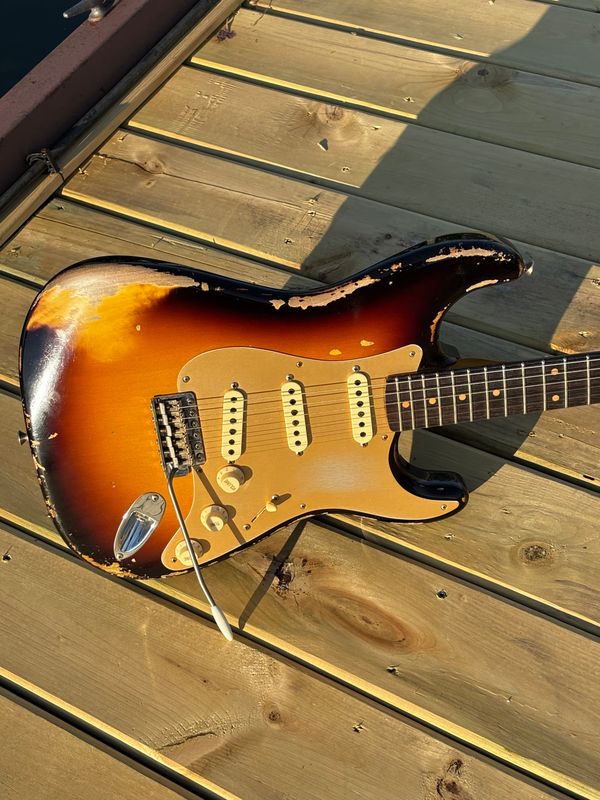
This is one of those guitars: 2017 Ltd Heavy Relic ’59 Strat Roasted
CZ542127
When I spotted this guitar, it reminded me of SRV’s original ’59 (which has since been documented as a combination of various parts from the late 50s and early 60s). The guitar at GC was a reliced sunburst and had an interesting tortoise shell pickguard, along with a beautiful looking roasted neck. Everything appeared to check out so I ordered her and waited anxiously for her to arrive at my local GC.
The thing you don’t know is if the guitar has had the pickups or other electronics changed out, which would be a deal-breaker for me. When the guitar arrived, Billy called and noted that the guitar had the original aged anodized gold pickguard in the case. I asked Billy to have his tech open her up to check if the pickups were original and, if so, swap them back into the original guard. Billy texted some pictures of the guitar opened up to verify these were the original Custom Shop pickups and I awaited getting her in my hands.
Excited, I forwarded the texted photos to my good buddy and fellow collector Eric.
Eric responded, “what’s with that chunk taken out of the body? It looks like the Cookie Monster got hold of that one…”
In my excitement over the revelation of the original pickups being present, I didn’t look closely enough at the photos… some idiot had hacked up the bridge pickup cavity, presumably to accommodate a humbucker at some point?
I should have cut this acquisition off right there and then.
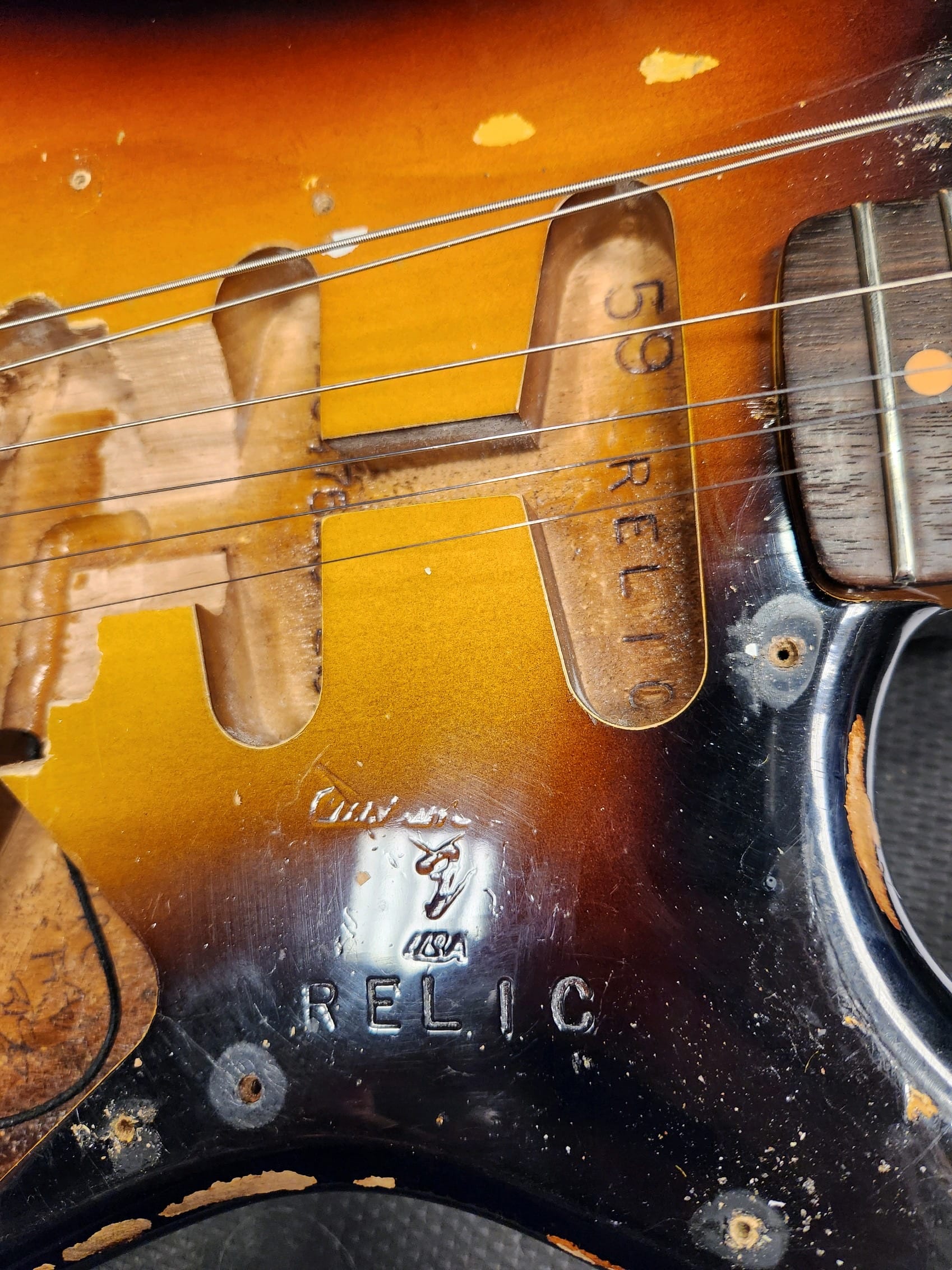
But in my giddiness, I decided I should get her and play her for a bit. I really wanted to try that roasted neck and see if any of that SRV-style magic was present in this guitar. I could always return it later.
Upon picking the guitar up from GC, the first thing I did (and always do) was to drop her off with Jesse at Clay Avenue Guitars who does all my setups. I won’t even play a guitar unless Jesse has worked his magic.
When I finally got the set-up guitar home, I was smitten. The guitar is really broken-in, it feels like an old, vintage guitar.
The guitar has the original gold anodized reliced pickguard. However – the back cover plate (also reliced anodized gold) was missing… UGH. You don’t know what I went through to track down a suitable replacement. It was a lot of hit-and-miss to find the correct part. The Custom Shop does not sell parts like this at a retail level. The commercially available components online proved to either be fake plastic made to look like metal, or had the incorrect string access hole fabrications. I finally found a correct plate made by Fender, but it lacked the relic work. I could always take some steel wool to it, but that may be a future consideration. In the meantime, the guitar is well on its way back to original parts/condition.
The roasted neck is wonderful. The neck is quartersawn roasted maple — this is the detail that drove my decision to keep it despite the hack job. The roasting process stabilizes the wood and changes the feel and resonance in ways that you notice immediately.
1959 was a year of transition for the Strat; In May of ’59, Fender changed the way necks were produced, switching from a one-piece maple neck to maple capped with a "slab" rosewood fingerboard. Appropriately, this guitar’s neck is topped with a period correct flat lam AAA CITES rosewood board.
Gum-Shoe Work.
Internet searches revealed much more about the history and provenance of this guitar. I was able to track down the original retail specs for this guitar listed by Humbucker Music in Chattanooga, TN.
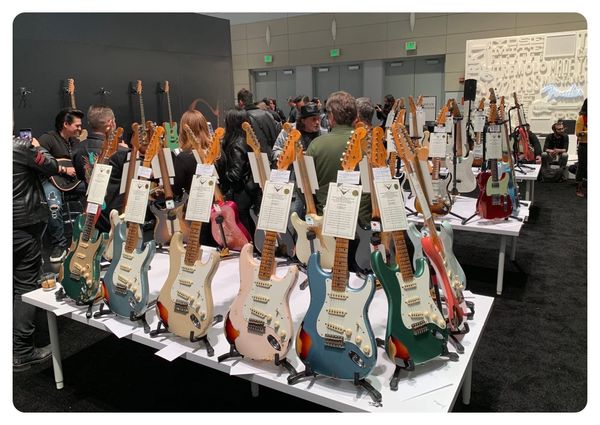
In 2017, the Custom Shop released a run of guitars for NAMM to commemorate 30 years of the Custom Shop: 1987-2017. This model was originally showcased at a previous NAMM convention, and proved popular enough that Fender reissued the guitar as one of their Top 20 NAMM Limited Editions. Instead of being a chronological run of reissues over the past few years, Fender reproduced these 20 instruments to showcase the most legendary and sought-after Custom Shop builds spanning their entire history. These models are a heavily-favored series of special editions. The Custom Shop logo on the headstock includes “1987 – 2017, 30th Anniversary” as a signifying mark.
I’ve discussed the opportunities to collect NAMM Limited Edition Guitars in a previous article.
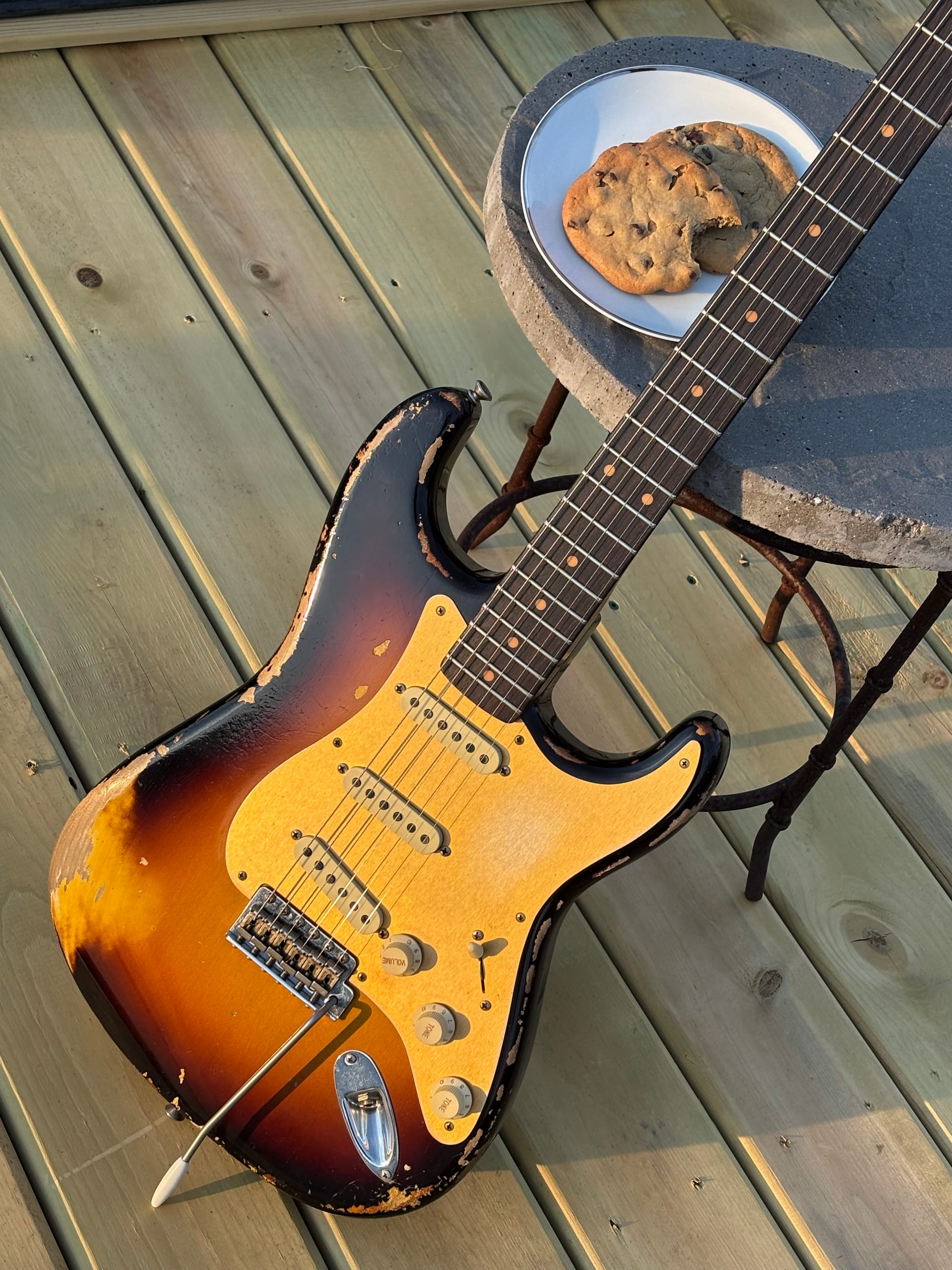
The Cookie Monster.
While I should have immediately returned this guitar due to the unfortunate hack-job, I am happy to have rescued her. The hack-job aside, I’ve returned The Cookie Monster to her original parts and condition, and she takes a special place in my collection. Just a cautionary tale – do your homework when it comes to buying used, especially from Guitar Center.