Two Blondes are Better Than One.
"I couldn't decide between two blonde Telecasters, so I didn't. Here's what happens when you buy both..."

– 6 min read
"I couldn't decide between two blonde Telecasters, so I didn't. Here's what happens when you buy both..."
Often, my wife will be looking at two expensive options for something, and she will ask my opinion. I usually respond with: “There was this one time when I was looking at two very expensive guitars and I couldn’t make up my mind; so to solve it, I just bought ‘em both…”
Granted, she doesn’t laugh. Nor should she; it may be a funny one-liner, but it’s not my best moment.
So begins the tale of the two blondes:
R131311
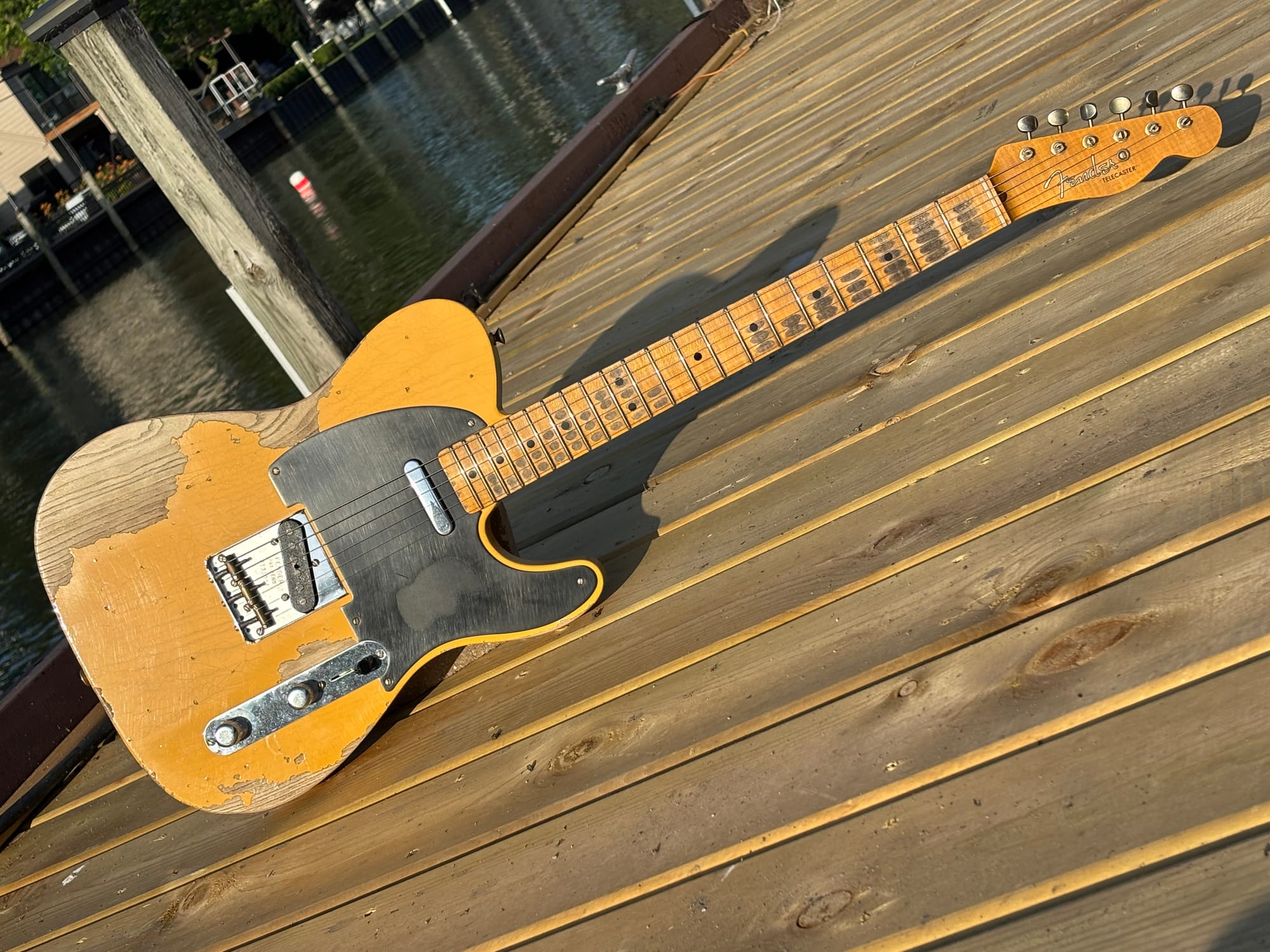
You may recall that there was a period when I was trying to distract myself from purchasing a 70th Anniversary Strat. That guitar was at Metronome Music in Mansfield, OH. While checking out that strat on Metronome’s website, I stumbled onto this guitar: a Fender Custom Shop LTD 1951 Telecaster, Heavy Relic- Aged Nocaster Blonde. I’d been on the hunt for a true vintage-style T-model: Esquire, Nocaster, Tele…
One afternoon shortly thereafter, I was picking my wife up from work and sitting alone in the car outside…waiting… waiting. That’s dangerous to leave me alone with idle hands… I dialed up Josh at Metronome and began to bounce some ideas back-n-forth. The next thing you know, I had fished my credit card out of my wallet and was rattling off the numbers just fast enough before my wife got to the car.
The guitar has an incredible heavy relic finish. It is also a Limited Edition, which if you’ve been following my other articles, you will know this checks a box for me when looking to add to my FCS collection. This guitar isn’t associated with any FCS dealer event; rather it’s from the Fender Custom Shop’s 2021 Collection.
She has a big ‘ole neck on her (did all ‘50s telecasters have huge baseball bat necks? I would not know firsthand, never having had the privilege). The AA Flame quarter-sawn neck has a compound radius (7.25 – 9.5) and a 10/56 “V” neck shape. Despite the huge neck, the combination of the compound radius, the soft “V” profile, and the relic finish result in a neck that is surprisingly comfortable to play.
The pickups are Hand-Wound '50-'51 Blackguard – purportedly faithful recreations of the original blackguards.
This Tele has the standard '51 Modified Nocaster Wiring with Bridge/Neck Blend.
The guitar also shipped with an optional Fat '50s wiring harness. The Fat '50s wiring is a bit more modern; this harness offers volume and tone control in all 3 switch positions, and a cap on the volume pot that keeps the high-end from getting lost when rolling back on the volume knob.
The 2-piece ash body is finished in “Nocaster Blonde” – not to be confused with the prototypical “butterscotch” finishes on Telecasters. The difference is really a matter of time. Nocaster Blonde reflects the lighter "White Blonde" finish those guitars left the factory with in the early fifties. Butterscotch is the color many of them became after sixty or seventy years of aging, as the clear nitro finish slowly yellowed. Fender's interpretation has varied considerably over the years—sometimes landing on a natural, convincing patina, and other times drifting into a bright yellow-orange color that can look a bit overcooked.
Today’s History Lesson.
This guitar brings us to an interesting point in history – and a story which I am certain you’ve heard countless times before.
This legendary model was originally born in 1950 as the Fender Broadcaster.
On Feb, 20, 1951, Fender received a Western Union Telegram from the Fred Gretsch Manufacturing Company requesting that Fender cease using the Broadcaster model name which Gretsch had used on some drums and banjos.
In an effort to stave off any further legal action, Fender management immediately pulled the Broadcaster name off the headstock of its guitars and from all advertising. For a few months, these guitars were produced and sold with no name on the headstock other than the Fender logo. This run of guitars became known as “Nocasters,” and represents an exceedingly rare and collectible guitar in the history of Fender. By April/May of 1951, the guitar was officially re-named the “Telecaster”.
R105923
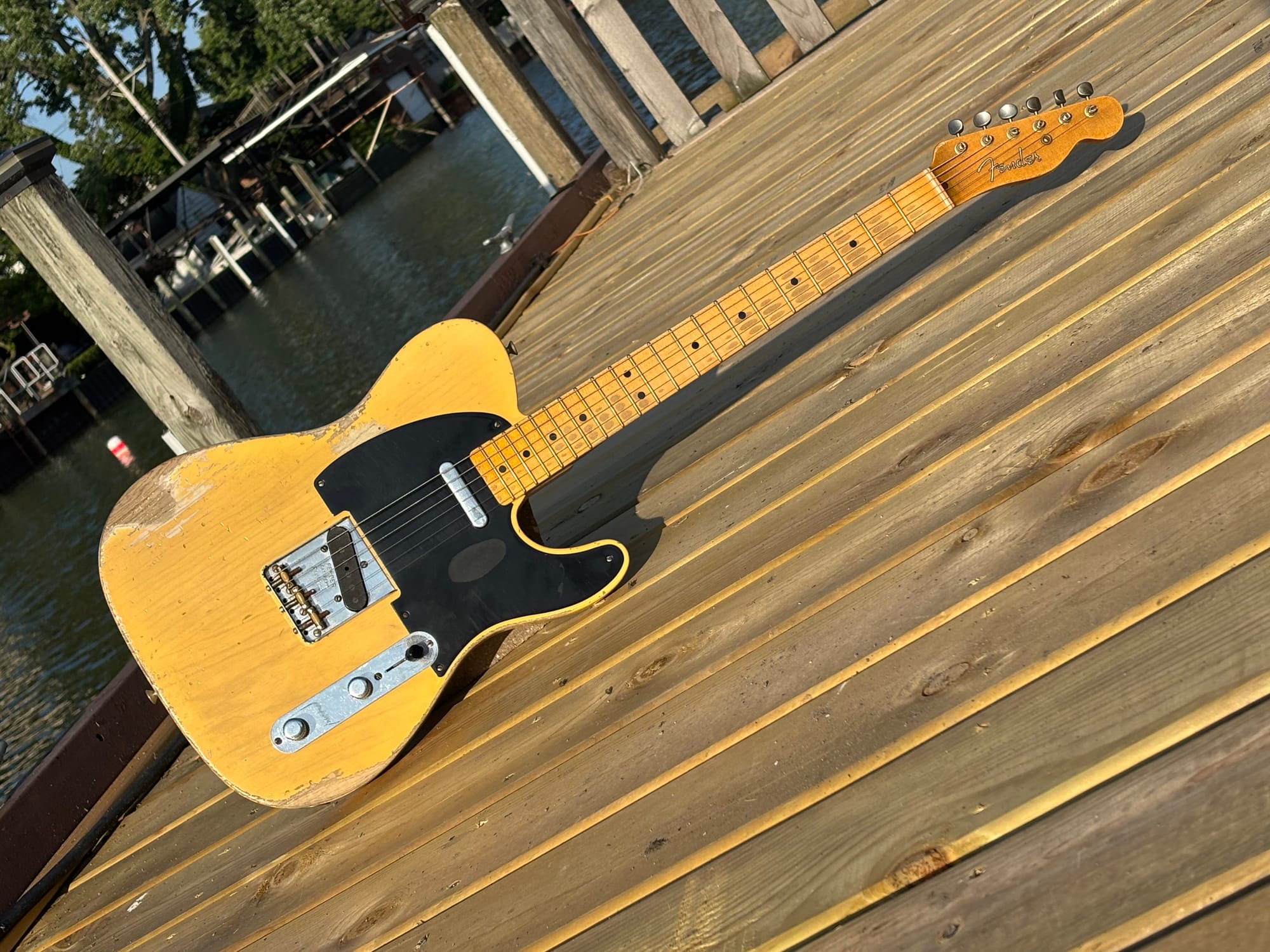
Two days after I purchased the ’51 described above, I bought this 2017 Ltd. NAMM 51 Nocaster Heavy Relic. I’ve previously espoused the virtues of these NAMM special edition guitars. Approximately 80 of this specific NAMM model were produced, with this one being built August 14th, 2020.
As I noted earlier, I’m fascinated with these early T-styles… I’d been chasing one of these official Nocasters for a bit. This one seemed to fit the bill.
This particular guitar had made the rounds; It started out at the Music Gallery in Highland Park, IL. From my research, I could see she had been back in on trade at one point, and she eventually showed up at Uncle Ike’s Music & Sound in Dubuque, IA. Zach at Uncle Ike’s was only too happy to accommodate me.
No idea why this guitar had been making the rounds; it’s a very nice guitar. It had met all my pre-requisite, non-negotiables: COA, Floor Traveler, original case, case candy, etc. I always take my newly acquired guitars to Jesse at Clay Avenue for initial set-up. Perhaps that’s why guitars like this make the rounds; no one ever bothers to have them perfectly set-up by a master luthier like Jesse.
The heavy relic work is not as (perhaps) overdone as the ’51 described above; it is very tastefully done. And there’s that big ‘ole honkin’ neck again… this time it’s a “Nocaster ‘U’” profile, at a 9.5” radius.
Now for the pickups; this is where things get interesting… As opposed to the HW 51 Blackguard pickups on the previous guitar we discussed above, this model has a Hand Wound Texas Special in the neck position, and a HW Nocaster pickup in the bridge position.
So what's the actual difference between the Nocaster and the Blackguard bridge pickups? Fender calls the Blackguard a "faithful recreation" and the Nocaster "period correct" — both bridge pickups run an Alnico 3 magnet, so on paper they're nearly identical.
Are you as confused as me? Thought so.
The Two Blondes.
So what happens when you get these two blondes alone together on the couch?
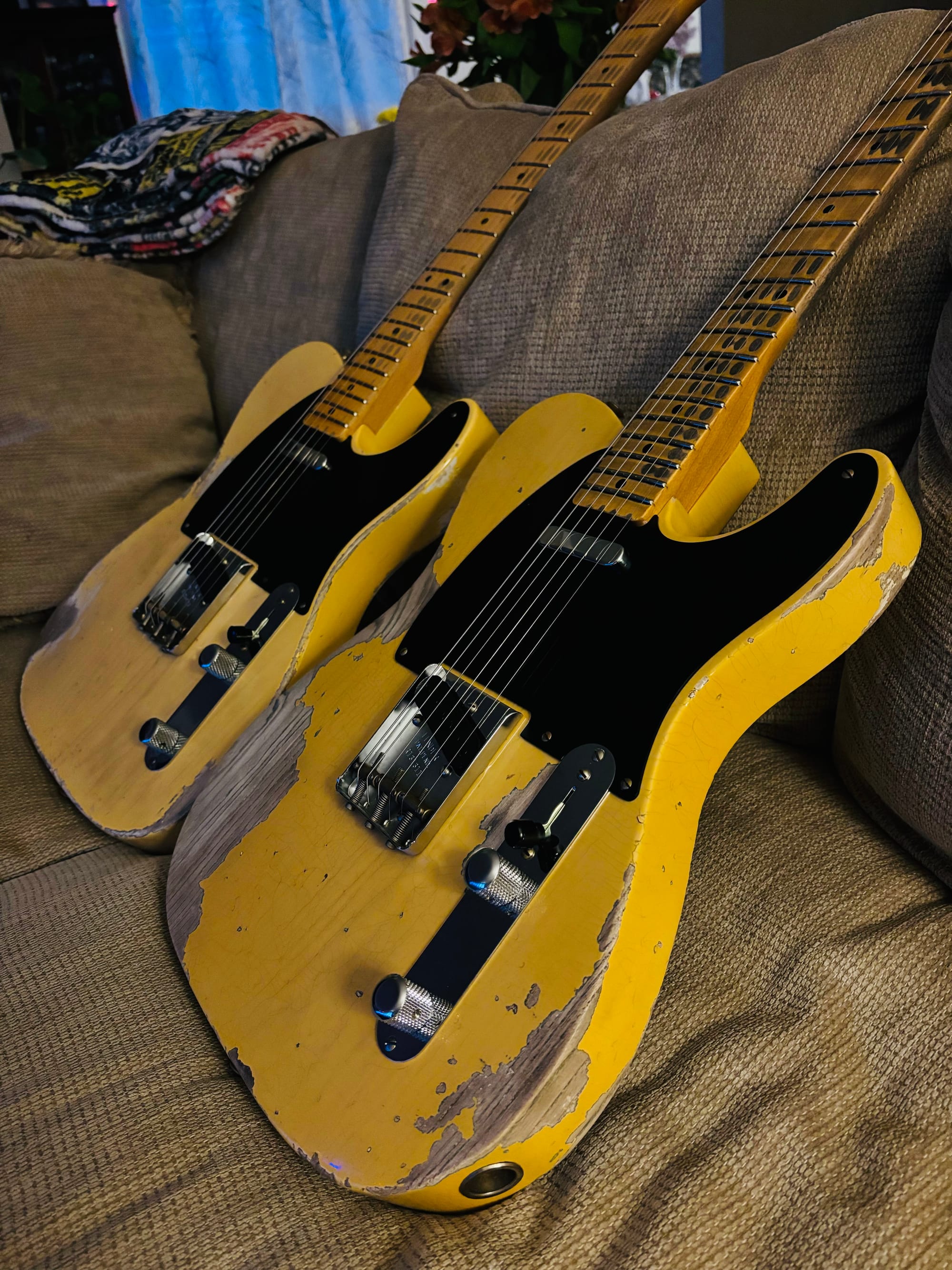
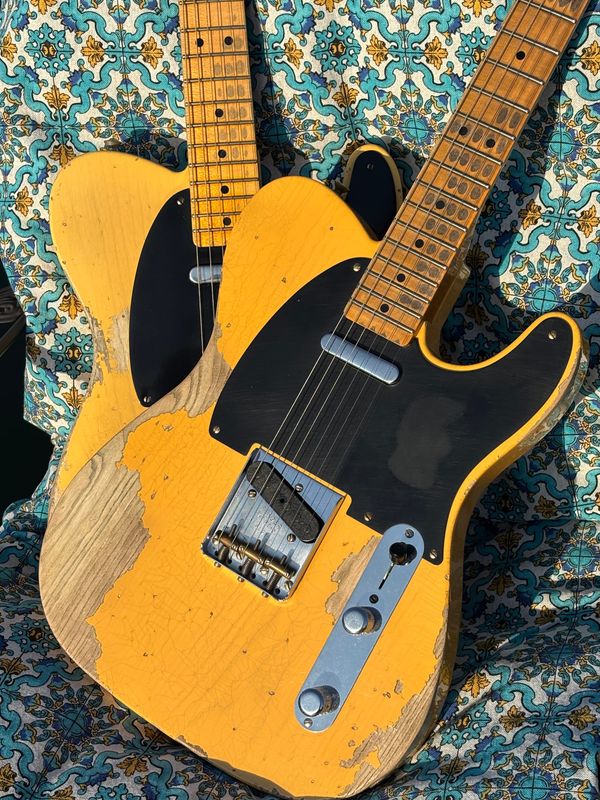
The two guitars share the same DNA; both guitars trace back to that same 1951 story, just from different ends of it — one from the no-name months, the other from right after Fender settled on 'Telecaster’ branding.
Although both are “Nocaster Blonde” in color, it's interesting to see the side-by-side difference between a 2020 build and a 2023 build from the Custom Shop — even though the Nocaster traces its design back to that original 2017 NAMM edition. The 2020 is slightly paler – or maybe it’s already aging and fading, as nitrocellulose should.
The necks are an interesting delineating factor.
The Nocaster neck is BIG and all up the board, as you would expect from the “U” profile at the 9.5” radius.
On the ’51 Tele, the compound radius and the “V” profile make the neck a bit more accommodating and comfortable to play.
So how do they sound?
In the bridge position, both guitars do what a Tele is meant to do – twangy. To my ears, the Nocaster bridge pickup has a bit more ‘snarl’ to it, but both do the job.
The neck pickups are where the differences lie: The HW Texas Special in the neck position of the Nocaster is bright and crystalline.
For the ’51 Tele, the HW Blackguard pickup in the neck position is warm and articulate – perfect for jazz chords and comping.
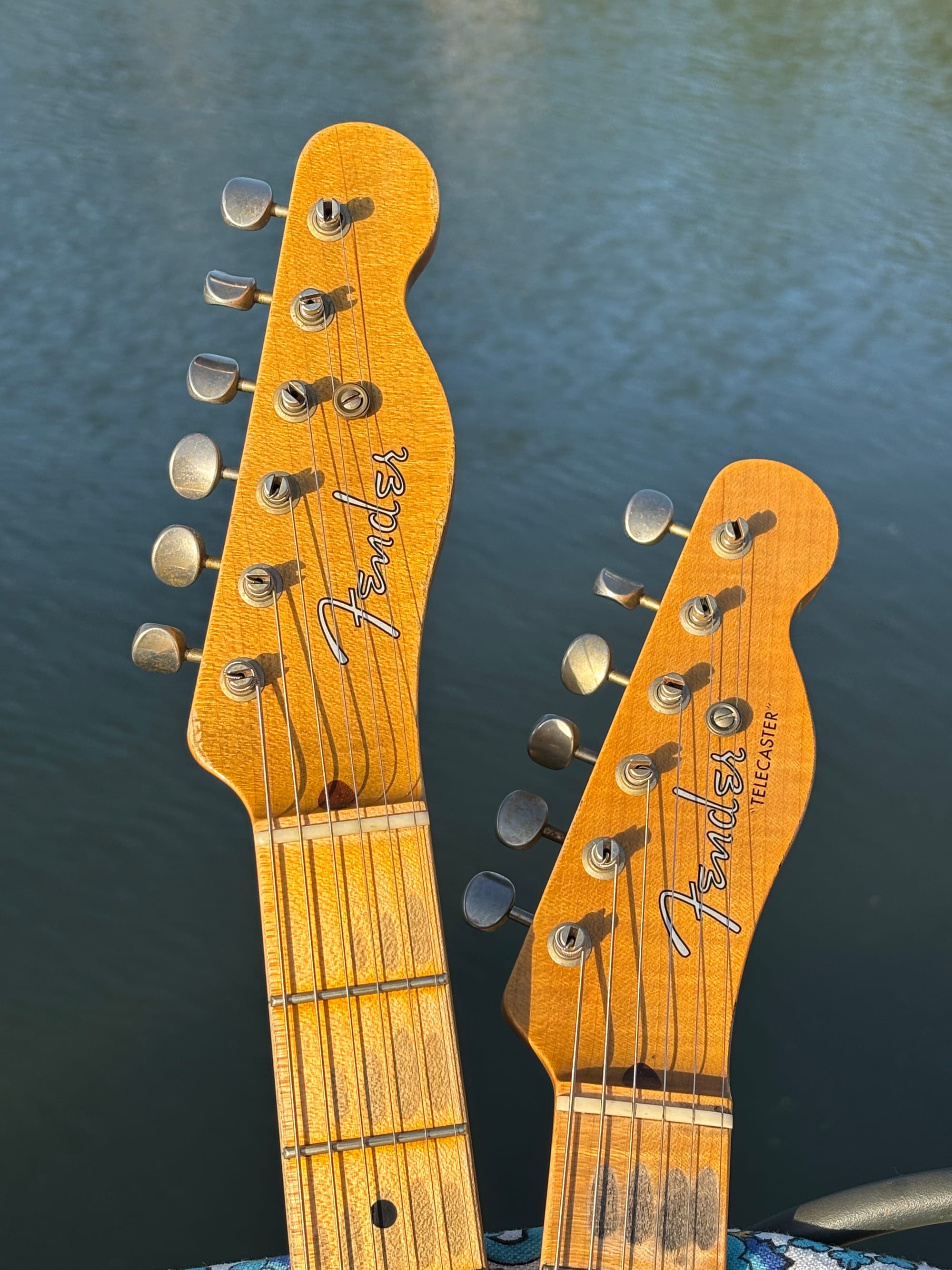
I think I will keep Two-Timing them…
I like both guitars and I am grateful to have them in my FCS collection; together, they definitely fulfill that need of what a 50’s style Telecaster should bring to the party.
I often see other similar ones which catch my eye, but then I remind myself that I have two good ones in my stash, both Limited Editions, and one with some NAMM provenance.