Wildwood 10 Telecaster – Are you Relic Ready?
"Relic Ready" sells you a blank canvas and hands you the brush. Three things ended up aging this guitar, and the owner was the least of them."

– 9 min read
"Relic Ready" sells you a blank canvas and hands you the brush. Three things ended up aging this guitar, and the owner was the least of them."
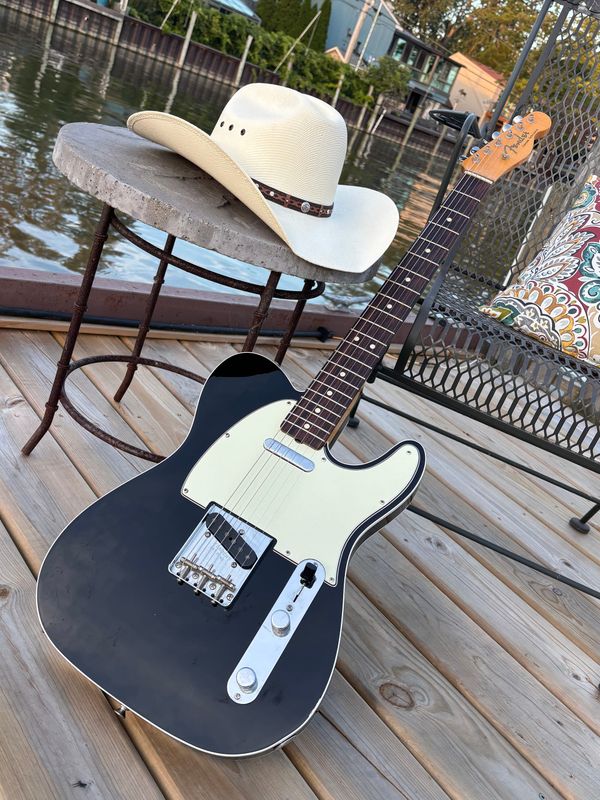
Res ipsa loquitur… “the thing speaks for itself”…
I mean to say – there’s no wild safari acquisition story here; no cat-and-mouse games, no police stations. Quite the contrary: this was a pretty bland, traditional purchase. Started out with a heads up from our buddy Eric about this used tele at our local Guitar Center. A couple phone calls to Billy and we were on our way to pick her up.
Not to say that this isn’t a pretty special guitar – it is. Here are a few reasons why.
The 1959 Custom Telecaster.
The Telecaster had been around since 1951 and changed relatively little through most of the decade. That changed in 1959, when Fender introduced the Custom Telecaster—the first significant variation on the original design. Two details immediately set it apart: an elegant double-bound alder body and a rosewood fingerboard, both firsts for the Telecaster in 1959 (albeit the rosewood boards were provided across the entire Fender guitar product line).
Until then, the Telecaster’s appeal had been almost industrial: a slab body, bolt-on neck, straightforward electronics and very little ornamentation. The Custom didn’t reinvent that formula. Fender simply dressed it up, adding a level of refinement to a guitar that had always been defined by its simplicity.
A bit of lore: Fender had no idea how to apply binding to a guitar. Every guitar Fender built was a slab of wood with a bolted-on neck. Binding is exactly that kind of time-consuming detail handwork that Fender avoided: routing a channel around the body's edge and fitting a plastic strip into it, on a curve.
According to Forrest White, who ran production at Fender’s Fullerton operation, he was invited to tour C.F. Martin's factory. There, Fred Martin personally walked Fender's people through their processes — how the binding was cut and applied.
For the new Custom Telecaster, a $30 premium ($229.50 versus $199.50) bought you the binding and not much else.
The Pete Anderson / ACL Connection.
This guitar immediately reminded me (looks-wise) of the Custom Esquire that Pete Anderson made famous during the iconic Dwight Yoakam appearance on Austin City Limits from 1988. If you’ve never seen it, do yourself a favor and google it. It’s a tour de force lesson in honky-tonk telecaster histrionics.
The Custom Esquire and Custom Telecaster arrived together in 1959, essentially as companion models. Both featured alder bodies, three-tone sunburst finishes and distinctive white binding around the front and back of the body. The real difference was simply the electronics: the Custom Esquire carried a single bridge pickup, while the Custom Telecaster had the familiar two-pickup arrangement.
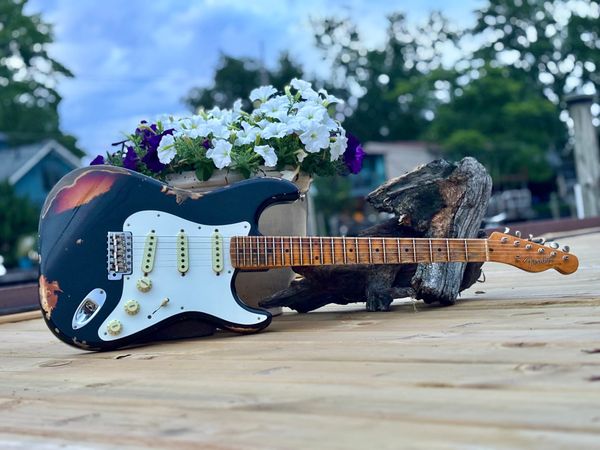
In keeping with the look of Pete Anderson’s guitar from ACL (which Pete had refinished in black), this guitar is affectionately referred to as a “Tuxedo” Telecaster: Solid gloss-black body matched with double white binding and a white pickguard. Although, in this specific case, the pickguard is of the off-green variety (more on that later). Suffice to say, she’s formal and commands respect.
Wildwood 10.
Wildwood Guitars is a well-known boutique guitar retailer based in Louisville, Colorado. Wildwood has become one of the most prominent dealers of Fender Custom Shop instruments, and is also known for its exclusive “Wildwood Spec” WW10 guitars—custom-ordered instruments built to specifications developed specifically for Wildwood.
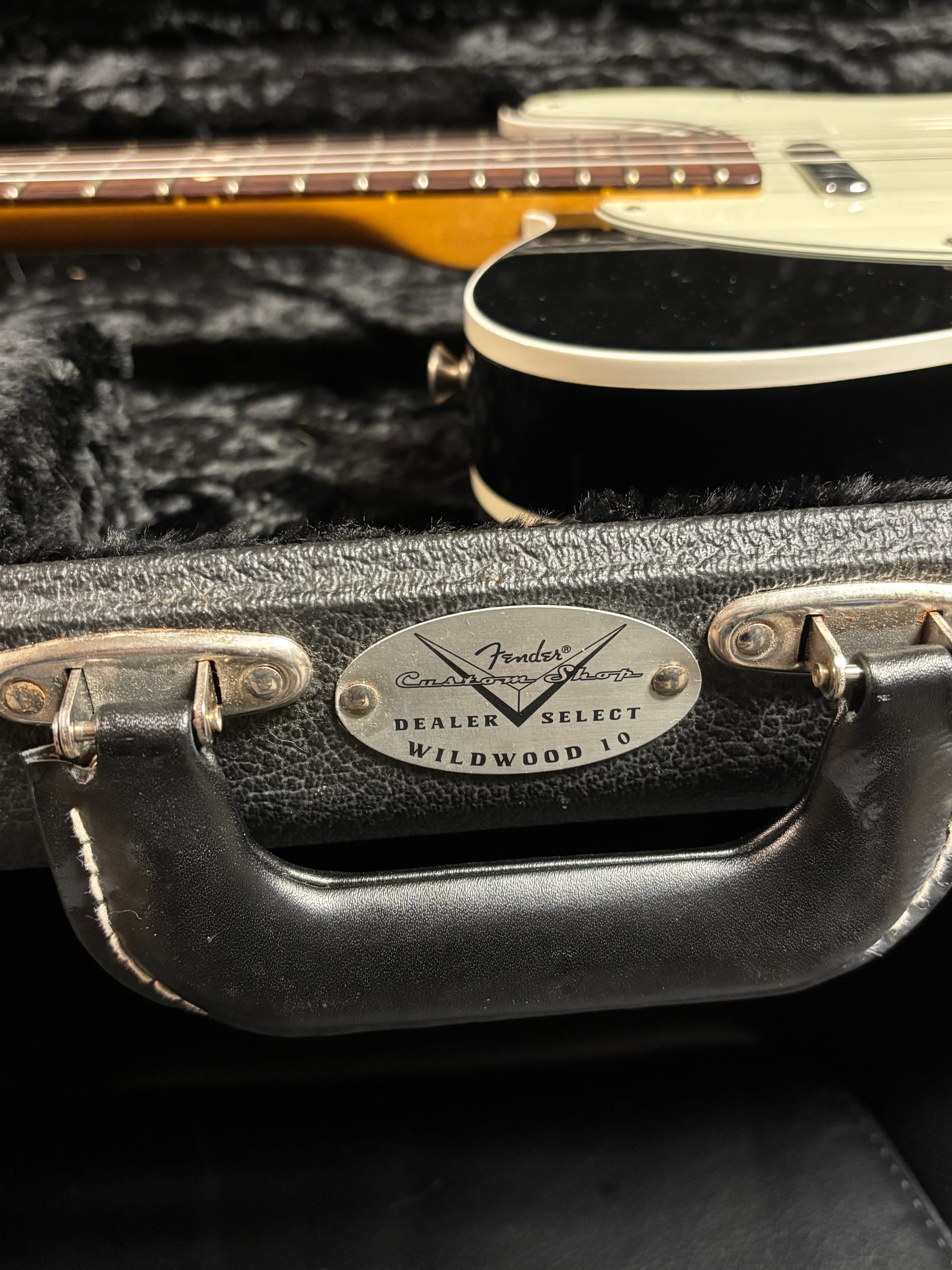
Wildwood 10s are Fender Custom Shop guitars built exclusively for Wildwood Guitars. They’re rooted in traditional vintage Fender designs—mostly Strats and Teles—but with a handful of specifications unique to Wildwood. The most recognizable is the 10-inch fretboard radius, a subtle departure from Fender’s traditional 7.25-inch vintage radius that gives the guitars a somewhat more modern playing feel without straying too far from their vintage roots. Also of note – this WW10 guitar is specifically spec’d to weigh under 7 ¾ lbs.
Josefina’s Special Touch.
Let’s dig in: this guitar is equipped with a set of WW10 Twisted Tele pickups, hand-wound by Josefina Campos, master pickup winder at the Fender Custom Shop. The Floor Traveler — the Custom Shop's own build sheet, and along with the COA the document that actually identifies a Custom Shop guitar — notes "WW10" on the back of the pickups, with the set wound specifically to Wildwood’s specifications.
Josefina joined Fender in 1991 and learned the art of pickup winding directly from the legendary Abigail Ybarra, whose own history stretched back to Fender’s earliest days. When Ybarra retired, Josefina became the next caretaker of that tradition.
Unlike a fully automated process, hand winding allows Josefina to control the wire tension and guide its movement across the coil herself. Those subtle variations are part of the point, contributing to the openness, responsiveness and organic character players associate with a great hand-wound pickup.
That craftsmanship has made Josefina-wound pickups particularly desirable among Fender players and collectors, with a reputation for clarity, warmth and vintage character. And there’s something undeniably cool about knowing the pickups in this guitar were wound by hand by someone carrying forward a tradition that reaches back to Fender’s earliest years.
Relic Ready.
This is where things get interesting – this guitar sports a “Relic Ready” finish treatment.
A “Relic Ready” finish is essentially an intentionally thin nitrocellulose lacquer finish designed to let the guitar age naturally through use. Unlike Fender’s factory-reliced finishes, the guitar body starts out clean and relatively pristine, without simulated dings, scratches, checking or other wear. The guitar body finish was left alone — but the hardware wasn't. The traveler's FINISH TYPE field reads RELIC W/CC HRW: Relic, with Closet Classic hardware. This is the second time reading the paperwork has told me something the model name didn't — the serial number is a much weaker signal than most buyers assume, and the build documents are where the truth lives...Fender aged the metal at the factory and handed me the rest of the job.
That said, the metal aging isn’t particularly noticeable; I have other FCS instruments where the bridge components show signs of discoloration and rusting; the metal on this tele looks near pristine, save for the tuners which look like they may have lost some of their luster. Perhaps that’s the difference in Closet Classic Hardware. In keeping with the retro-vibe, this tele sports a 60-64 Green/Black/Green nitro pickguard. The guard is not “all scratched up” and frankly, the green is subtle enough that it does not radically conflict with the white binding on the body. It looks very natural and under-stated. The mint-green pickguard is intended to replicate the way a white celluloid pickguard yellows over time. It's simulated aging, on the front of the guitar, alongside the Closet Classic hardware.
The body finish utilizes a “Thin-Skin Lacquer” which comprises only 3 or 4 clear coat layers instead of a thick standard finish. The guitar leaves the Shop looking clean (NOS style – New Old Stock) without intentional scratches, dents, or artificial rust. The difference is in the finish itself: with fewer layers of lacquer and none of the heavier build associated with more conventional finishes, it is much more susceptible to the effects of playing, handling and time.
The idea is that rather than having the Custom Shop recreate decades of wear at the factory, a Relic Ready guitar develops that character on its own. Regular playing can quickly produce the small scratches, worn areas, and other imperfections normally associated with an older nitro-finished guitar. In effect, Fender and Wildwood provide the starting point, and the owner creates the relic themselves, personalized. In fact, the Floor Traveler goes so far as to state “Buff as NOS, no checking or dings”. This is Fender certifying, in writing, that this body had no checking when it left the Shop in October 2019.
The paperwork further informs that this guitar was built 10/03/2019, and I purchased her on 5/25/2023. The Relic Ready finish depends on an owner who plays it. This guitar has had two owners in seven years; I bought the guitar as a piece to add to my collection, and truth be told – I do not beat my guitars up that bad. So, the few dings are the work of the prior owner. The checking is a different story.
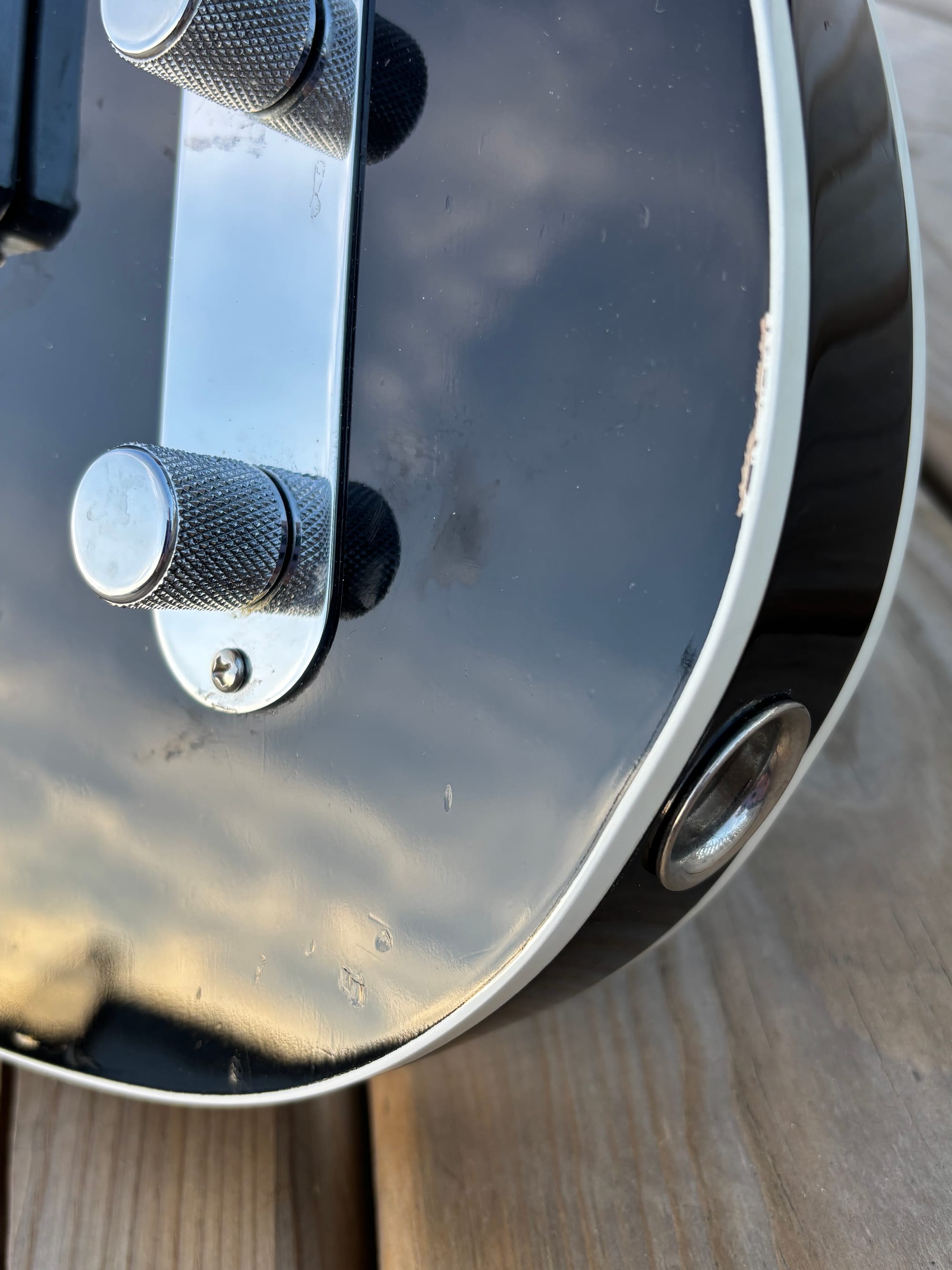
Nitro finish checking is not caused by playing and handling the guitar — it comes from thermal cycling and the lacquer gassing off, shrinking, and turning brittle. Also, thin finishes check more readily because there's less paint material. So, the finish is doing exactly what Relic Ready promises, without relying entirely on the player to “relic it up”. Seven years in, the checking is there, but it's so fine you have to hunt for it under a raking light. A camera won't hold it.
There are three separate causes of aging on this guitar: the factory (Closet Classic hardware, mint guard), the chemistry (checking), and the owners (a few dings in seven years, across two people).
Let’s Saddle Up.
The guitar is surprisingly light; the “less than 7 ¾ lb” body specification really holds up as the guitar is really comfortable to hold.
The 10” radius neck is also very comfortable; it doesn't feel like the fat, baseball-bat neck common to other vintage-style Teles, even ones with more typical radius measurements.
The bridge pickup sparkles – very bright and pleasant sounding, unlike the ice-pick sound associated with other tele bridge pickups. The neck pickup however, leaves quite a bit to be desired; it’s disappointingly quiet, and quite a drop in volume when switching from bridge to neck.
This guitar's specifications are vintage-correct everywhere except its wiring, which is somewhat ironic on an instrument spec'd this carefully. The traveler calls for "mod wiring" — the modern neck / both / bridge switching that Fender adopted in late 1967, not the circuit a real '62 would have carried. Which matters here: modern wiring leaves the neck pickup no vintage tone-circuit quirks to hide behind, so the volume drop is a bit more suspicious. I may want to further inspect this wiring at some point to assure everything is connected appropriately.
Aging gracefully.
Watching this guitar’s thin-skin finish age on its own makes it a uniquely organic specimen within my collection. My other Fender Custom Shop relic guitars generally feature pretty tough finishes, despite heavy relic’ing work. Those other guitars are not easily prone to chipping and checking; they arrived pre-checked, with the aging already done to them. This guitar is doing it itself.
The other salient features – the Josefina pickups, the 10” radius neck, and the highly curated selection of light-weight wood, further contribute to a quality collection piece.
The Specs
| Model | Fender Custom Shop Wildwood 10 1962 Telecaster Custom, “Relic Ready” — traveler GENERAL line reads “WW10 62 TELE CUST REL READY RW – BLK”; base model is the Custom Shop ’60 Tele Custom (CS153300), decal reads “59–63 Tele Custom” |
|---|---|
| Serial | R99856 |
| Built | October 3, 2019 — Wildwood Guitars dealer order (Sales Order 12048456-000020, Production Order 102146797, Seq 19364); requested delivery October 12, 2019. Masterbuilder field blank, team built. COA dated October 8, 2019, signed C.W. Fleming |
| Finish | Black (06), thin-skin nitrocellulose. Traveler FINISH TYPE reads “RELIC W/CC HRW” (RL1); body notes read “thin skin lacquer finish / buff as NOS / no checking or dings.” “Relic Ready” appears only on the certificate instruction line: “CERT: WW10 RELIC READY… 1962 Tele Custom” |
| Body | Two-piece alder, double-bound top and back in .060 white nitrate binding. Order specified “must weigh under 7¾ lbs” |
| Neck | Quarter-sawn maple, spec’d “like 63 Tele NOS,” medium-tint nitro; 60-style Oval “C” (.820″ at the first fret, .890″ at the twelfth); early-’60s truss rod; flat-lam CITES rosewood fingerboard, AAA 9mm, sorted for dark stock; bone nut, 1.650″; butt width 2.200″; Micarta white face and side dots |
| Frets | 21, narrow-tall 6105; 10″ radius |
| Headstock | Tele style, ’60 scoop, .575″ thickness; “59–63 Tele Custom” decal plus Limited Edition decal; vintage tuners with Fender logo; American Vintage 59–64 metal string tree; no headstock binding |
| Pickups | Josefina Campos hand-wound WW10 Twisted Tele set, neck and bridge; “WW10” written on the backs |
| Controls | Present-day Tele control assembly, 3-way switch, knurled chrome volume knob, Tele switch tip — traveler notes “MOD WIRING” |
| Bridge | Tele 58–63 bridge plate (without pickup); vintage Tele output jack |
| Hardware | Chrome/nickel plating, Closet Classic aged; R-series vintage neck plate; 60–64 Tele green/black/green nitro pickguard; 010–046 strings |
| Case | Wildwood 10 case, with neck-rash prevention |